Pages

Showing posts with label Cultural Exchange. Show all posts

Wednesday, June 19, 2013

Life is Sweet, Man

About a year ago, Aimee and I were hitch-hiking down to our In-Service Training.  After a very long wait, we were finally picked up by a Rastafarian trucker. Now I've since learned that hitching in big rigs can add hours and hours to your trip- this lesson learned during this ride to Gabs. And yet, what started out as as a slow hitch south eventually turned into a hilariously insightful trip and one of the most memorable rides I've had in Botswana. We were left with the advice "Life is sweet, man, life is sweet." And a year later, life is feeling very sweet, indeed.

My projects are going really well! Activities I have been pushing for months are not just 'happening,' but the participants have been actively engaged in discussions and visible progress is being made!

JSS PACT Club Girls and me with our identity collages 

JSS PACT Club: My Junior School PACT Club has really come together- the past few meetings the group has connected and all of the girls are active participants in conversations and activities. Further, we've been tackling increasingly challenging issues lately, and the girls have been responding thoughtfully. The previous term I was lucky if the meetings even happened at all, so this change has been so exciting to see! Plus, we've been having a lot of fun hanging out before and after meetings!


Voices of the Community: The women's group that my fellow PCVs and I have been working with for months has not only been very active, they've been drawing in new members, old members are now the ones doing the training sessions we originally taught them, and PCVs aren't the ones driving the meetings forward. The members have also become a fantastic resource the community; the group has been approached by individuals in need of advocacy while maneuvering through a convoluted legal system! I can't wait to see what this group can do next. 
I love this photo! Voices celebrating a successful project with a braii (bbq)

Teenage Pregnancy Prevention: Over a weekend, the team at the junior secondary school and I managed to talk to nearly every student out of the 800+ enrolled about teenage pregnancy prevention. The schools start their six week break at the end of June; year after year, 9 months after these breaks the school sees several students dropping out due to pregnancy. We split the youth into small groups and just cycled through presentations regarding the implications of teenage pregnancy, delaying sexual debut, condom use, and contraception. Most of the students were active participants in the discussions and willing to demonstrate condom use or explain another form of contraception to their peers, so hopefully the Etsha JSS will see fewer dropouts due to pregnancy next term!


World Tobacco Free Day: My clinic and I put together a community event for the global commemoration. This was a project that seemed to fall into pieces, up until the last minute when everything came together- and managed to draw a large crowd! Even without snacks, a solid group met to march through the village singing and holding posters depicting the dangers of tobacco use, drawing hundreds to the kgotla where we delivered a health talk and skit encouraging the community to be tobacco free.


And I can't say my life has been all work and no play! My weekends have been full with some pretty incredible experiences lately.

Hippos on the way to Jao
Jao: My village is largely made up of two ethnic groups: Bayeii and Hambukushu. The 13 Etsha villages were built as settlements for Angolan refugees in the 1970s, many of them Hambukushu (though Hambukushu also lived in this area previously). The Bayeii people are people of the delta, and have gradually moved in towards the Etshas to have access to medical care, schools, and shops. My friend Jamie's research is centered around access to natural resources and I could (and probably will at some point) write an entire post about what she has learned about the Etshas. To keep it brief, I was accompanied her to Jao Island, where many Bayeii people living in Etsha consider their home village. It's a beautiful hour boat ride through the heart of the delta, past countless tiny islands and through both lagoons and narrow channels. 

Backing up in preparation of our 'flight'
This photo may not look like anything too interesting, but the papyrus had moved to block the channel (papyrus, the plant in the photo, actually floats along the water rather than growing out of islands). Ishmael, our driver, said to us "Alright girls, so the island has moved to block the channel, we're going be flying over the papyrus!" We assumed he was joking, as last time we had managed to push the plant blockage out of the way, but he wasn't. We actually backed the boat up and 'flew' the boat over top the island and continued on our way. 

Once out at Jao, we spoke with village elders, including a 100 year old man, fishermen, and saw the beautiful village nestled among the delta reeds. We also went out to a few fishing posts, including one built around a termite mound island! It was incredible to see more of the culture I’m living among.
Tent atop a carved termite mound. Most creative set up I've seen!

Enjoying sunset on the lagoon (photo credit to Jamie)
Guma Lagoon Camp: While my dad was visiting, he wasn't too keen on roughing it in Etsha, so I decided to send them to the lodge just outside my village. We ended up making friends, so Aimee, Jamie and I decided to head out there again! We soaked up a little bit of sunshine by their pool, enjoyed the view of the lagoon, took ample advantage of their hot showers, and took a boat ride out for sundowners. Oh, and Aimee was nearly run over by a hippo chomping his way to the fancy grass to the pool (only the deadliest animal in Africa, no big deal). 


So metal.


Ghanzi Metal Fest: One of the most interesting sub-cultures I’ve come across, Botswana is home to the aptly named ‘metal cowboys.' They don leather chaps, studded cowboy hats and chains, and listen to the likes of Slipknot, Iron Maiden, and some Batswana versions of metal music. As one of the most unexpected forms of Botswana culture, of course some PCVs and I had to check it out. 


Next week I'm headed to Gaborone for my In-Service Training. This is the last of the mid-milestones to cross; I'm past the one year mark, past the halfway mark, past the one year as a PCV (as opposed to a trainee) mark. Over the past month or so, I've noticed a significant shift in my attitude about living in Botswana. This feels like 'real life,' rather than something I'm just passing through, and it's a really fabulous real life to be living. Water outages, electricity 'brown outs,' bugs, cold, heat... have become manageable, easily handled in fact. I remember there was a point where my mood coincided with whether or not the water was on. I had a realization during a run last week that I was actually look forward to kids screaming 'Loraaaaaatoooo' and running with me and the mosadi magolos saying, 'ah! next time I will come with you!' These things originally prevented me from wanting to run in the village and used to drive me crazy during my 'me time.' I have less than a year left, and suddenly it feels like my time here is moving too quickly.


Monday, June 3, 2013

American Visitors

My dad and two of his friends came out to Botswana, and here are some of the highlights from their trip:

After a bit of a hold up at customs (thanks for all the beer, dad!), they finally made it through the Maun airport

I swear we were actually really excited about the herd of giraffe behind us, in Nxai Pan/Makgadikgadi National Parks

In front of a massive boabab out a Baines Baobabs, with a salt pan behind us


Dinner with Matt, Bridgette and their American visitors out a friend's game farm!

Catching tiger fish on the Okavango Delta!

We also spent time going to my projects in my village, buying meat from the 'local butcher' under a tree, hauling in water from the river as my water was off, watched a herd of 40+ elephants less than five miles outside my village stomp around the delta, ate game meat, and just generally showed off how amazing this place can be.

Friday, April 5, 2013

Life on the Floodplain


My friend, researcher, and fellow Etshan, Jamie has been kind enough to let me follow her around on some of her interviews. She is researching environmental change and how these changes affect people; more specifically, how the changing flood patterns are affecting the  livelihoods of the Etsha community members, who often rely on natural resources from the floodplain.  In recent years people have been flooded out of their homes and fields, and the government response has been varied. These interviews have been fascinating and my understanding of the Bayeii and Hambukushu cultures I'm living among has increased tenfold. They have also given me peak into the daily lives of my community and the opportunity to catch some of it through photographs. The following pictures are from interviews that occurred just outside Etsha 13 and Etsha 6 at families 'lands.' Family units in Botswana traditionally have three homes: their home in the village, their aptly named cattle post, and the 'lands' where they farm.


This is an old Bayeii man. The Bayeii are people of the Delta, a small minority among Batswana. Speakers of their language are diminishing (most Bayeii children I know speak more Setswana than Seyeii) and government policy favors moving them out and away from their 'traditional' land near the water.


This is a Bayeii woman standing outside of her molapo, or floodplain field.  Just beyond the fencing in the background is a main channel of the Okavnago Delta. Her plot is about 5-7km outside of Etsha 6 village as the crow flies, but this channel of water must be crossed, so the pathway we took in a vehicle was about an hour drive. Women are traditionally responsible for maintaining and harvesting the crops (while men do the plowing to first prep the soil). Most people dry land farm throughout Botswana and even within the villages along the Okavango Delta.Rumor has it the land along the panhandle and western side of the delta is being reserved for tourism development, meaning that these floodplain fields are less common. The thing that struck me the most about the molapo field was the color of the soil- dark brown, very different from the sand of the dry land plots.

This is a reed hut at a family's 'lands,' Reeds and grasses used for these structures are collected from the delta. While mud huts are still quite common in this area, reeds and grasses make up a large portion of shelter materials. In town, there is also a move towards cement houses, but the reeds and grasses are still quite commonly used as roofing and fencing materials. 


The kids have been on a school break for the past few weeks, and during these breaks, children often go back to their home villages, visit other family members, and/or come out to the cattle posts and lands to help their families.  

A young girl walking back from the 'lands' through the floodplain. We were walking through about 6 inches of flood water. The floods are in their upswing right now, and from what I saw last year, peak  around June/July. The water in the delta comes from the Angolan highlands, and rumors say that there has been a lot of rain there this year. But Botswana has had drought-like levels of rain this year, so flood level predictions are uncertain.


Tuesday, November 20, 2012

Americans in Africa

My mama and friends came to visit, which meant I got to spend some quality time with them exploring Bots and the surrounding areas! 

We went on an AMAZING safari- we were told that it was some of the best game viewing he'd ever seen by someone living here. We saw tons of giraffes, hippos, crocs, hoofed creatures, zebra, lions, literally hundreds and hundreds of elephants, two leopards and a wild dog (only about 2000 left in the world!

This lovely lady leopard walked right up to our vehicle!


some of the hundreds of elephants we saw

lion post meal


We also shimmied over to Victoria Falls in Zimbabwe; the falls were beautiful but the bureaucracy in Zim was not so great.  

Then, we took a quick jaunt through the Caprivi strip in Namibia, stopping over to stay in some amazing tree houses and back down to my village. The ladies helped out in my clinic, with my PACT Club, learned about basket weaving, and spent a little time on the Okavango River.

It was a wonderful whirlwind of a time and so nice to show my mama and friends my life here. It's hard to explain all of the crazy details over facebook or a blog, so I'm happy that more people were able to see this wonderful, challenging, hot, beautiful place. 

A special thank you to everyone who sent stuff with my mom over here... as I told most of you already, I brought it back up to my village after sending my visitors off... it lead to a lot of laughing and crying at the same time. Most of all it made me feel so much love and support- KE A LEBOGA THATA THATA! You are all amazing. A special thank you as well to my mom, Lori, Kathy, and Karen for hauling all of that across the world and for coming all the way to see my life here. <3


Thursday, September 20, 2012

The Training Wheels Are Off...


Being back in the village has been BUSY! And mostly awesome. Now that the training wheels of the community assessment are long gone, highlights include:
·       -  My windows have been fixed! No more chicken wire or boarded up windows.
·        - A series of productive meetings that led to PACT Club (youth health club) and HIV/AIDS Support Group meetings actually getting scheduled and planned.
·         -MAIL!!!!! Letters and packages galore. AMAZING. Thanks mom/dad, Aunt Tam, Grandpa Steve and Jan for some incredible, awesome, delicious, and fun things and  a little bit of ‘Merica.
·         -Observing/assisting with the basic non-bodily fluid based stuff of a birth! This was pretty awesome and slightly terrifying but mostly awesome. I was only able to observe/help with the tail end of things because she began during the lunch break, but hopefully I’ll get to help with another one soon.
·         -The first elephant sighting! Aimee and I had been on a mission to see an elephant for weeks, with the running joke that we only see animals after we’ve had really frustrating and unproductive days. The elephant showed itself after we had spent the day in Gumare trying, to no avail, to get our furniture sorted out. Just when Botswana has beaten ya down, an elephant will charge in front of your bus.
·        - Obtaining fruit trees for my clinic’s garden. And it was easy. Next to nothing is simple here… I showed up to the forestry department at 4pm on a Friday and someone was there, and she was helpful. Then on Tuesday, my clinic found transport to pick up the fruit trees. And we went and picked them up without a hassle. For all of these things to just happen, without any issues was absolutely amazing.
·         -Chicken slaughter (sacrifice!). Aimee and I, with the help of our friend Theo, slaughter, cleaned and cooked a chicken.  And then ate chicken tacos with some of the tasty stuff sent in care packages.
·         -Fishing on the delta. Obviously, that was amazing too. I think this picture explains why.
·         Taking my new friend, Moloi, home! Now I’m not really a cat person, but I have to say he/she (sex tba) is growing on me. Plus, I haven’t seen
·          -Turning 23 years of age.  I was able to see the Gumare crew, have more actually productive meetings, braii and video skype with my family for the first time in five months. And then get to party it up over the weekend in Maun for a joint bday celebration. Wonderful.
·         -First PACT Club meeting with the Junior Secondary School students, and it went well! I’m really looking forward to working with them and other students in the area.
·         -Teen Club, a group for HIV positive youth (almost all members were born HIV+) is up and running! Our first official meeting will be this weekend.


It’s funny, because during IST I was nervous about heading back to my quiet, little village after being around so  many Americans and shopping malls for a couple of weeks, plus the added pressure and expectation that projects would be off the ground and functioning. But almost magically, things starting falling together and programs that I had been pushing for weeks began to take off. There is a whole bunch of good things ahead too- Family Bonding workshop, GLOW camp (youth life skills stuff), Breastfeeding Day, and I’m starting aerobics classes twice a week in the evening. For the first time since being in Botswana, I’m feeling a little stressed about my workload! It’s nice change of pace J

Monday, August 13, 2012

My Life With Out Windows


I thought I would share one of the more frustrating (and funny) experiences I have had here. Most of the time, I am so happy that I am here and feel very content with my decision to join Peace Corps, even with the occasional issue or discomfort. My windows have been a source of frustration over the past few weeks, and I want to explain what happened with them today.

So my back windows are made of chicken wire. No glass, no screens, just chicken wire. Now I can lock the door to the rest of my house, which includes everything but the toilet and tub rooms, so safety isn’t my greatest concern (though I do find it a bit worrisome). But, as I have mentioned before, I live on a lake, so even though it isn’t the rainy season, I have a disgusting amount of mosquitoes and I live in a malaria endemic region. Thus, I have been trying to get the buildings department to come out and do something about the chicken-wire-window-mathata. Now by this, I mean that I have been going to Gumare just about every week, making phone calls and using up my airtime, just to get to no answers or assistance in dealing with this since I arrived in Etsha 13.

After many hours of frustration, in my last visit to the buildings dept in Gumare before heading south to a workshop and then IST (which means I will be out of my village for over two weeks), I (nicely) made it clear that I was not pleased that I had to leave my house with this still an issue, as burglary is a common issue in my region. Due to my past experiences, I didn’t really think that I would see them again before I left, but lo and behold, guess who showed up on my doorstep today? Why, the buildings department crew of course!

Initially, I had a wave of excitement, until I saw what the back of the pickup held… just two large plywood pieces. And that was all. A look of confusion crossed my face, and the very nice man that I have been working with hastily explained that they were going to board up my windows, temporarily. His use of the word “temporarily” was very disheartening to me, because based off experience that most likely meant the boarded up windows would come down sometime around June 2014.

As they boarded up my windows, the nice man could tell I was not very pleased with the whole thing. I was trying not to be a total brat about the situation because he had come all the way up to Etsha 13 on short notice, but again, see the June 2014 comment to understand my frustration. Once the crew was done, he asked me to clarify what I wanted with the windows as he sensed my displeasure. I explained that it was very important that I didn’t live in a cave for the next two years, and that I just wanted screens, simple screens is all. To which he replied, “what do you mean by screens? Isn’t this some form of screening, now people can’t see in? We had thought you maybe wanted the windows bricked in or boarded up?” Apparently, the buildings department calls what Americans know as screens, guaze and had no clue what I have been talking about for the past two months. Language barrier: 1, Boo: 0. 

Thursday, July 26, 2012

Top Five Reasons I Love My Village


5. The size. One of the things I thought I would be missing out on by coming to Botswana was the ‘traditional Peace Corps Experience’ that most volunteers have worldwide. Many volunteers in Botswana are placed in more urban settings, working in offices or the like so I was anticipating this to be the case for me. Turns out, I still get to live in rural Botswana and work out in the community, living in a village where most people know who I am (even if I have no clue if I have met them before or not).  About a week after I was introduced in the Kgotla (where meetings with the chief and other community leaders happen), all of these kids suddenly knew my Setswana name. I’ll walk by and they will either scream it “Loooooorrrrrrraato!” or they’ll whisper “Lorato,” just to see if I’ll really respond to it. Then I’ll look at them and say hi and about half will laugh and run away. I just wouldn’t get that in bigger villages.

4. The house. I may never get my bathroom sink fixed, who knows when the rest of my furniture is coming, and I’ll have lizards, bats, and semi-posionous spiders until I leave here, but my house is pretty plush. I have running water and electricity, and two bedrooms! And besides all of that great stuff, I have a cute little breakfast nook (chicken wire windows to be replaced) that looks onto a flood lake, at least for a little while longer, and into an awesomely traditional and beautiful compound with the best opportunities to people watch. They’re building a reed hut now, and pounding sorghum. It’s awesome.

3. The job. I get to make my own job, how awesome is that?! These first two months have been me assessing what the community actually wants and needs from me, and now I get to decide what to work on. I am just so excited to get up and go to work every day, seriously even analyzing HIV testing data is fun. How often can that be said about data analysis? My week generally start with some sort of plan, and then next to nothing happens the way I think it will. Luckily, something usually ends up working out one way or another, with a little wait time of course, but I can usually find something else to do in the meantime, like plan what I want my job to be. Plus, I get to work in exactly the area I have wanted to work in for years.

2. The Arts. For every event I have been to in Etsha 13at least one if not several traditional dance groups show up and perform, and each style is different and each dance tells a story. There are also usually musicians that come along with the performances. Most of all, I’m in the basket weaving capital of Botswana! I’m working with some wonderful women to get the basket crafts a little further off the ground and they’re going to teach me how to weave. It’s a crafters paradise!


1. The Combo. The fact that all of these things are combined into one site is awesome.  I get to live in a small village in a rural part of the peaceful country of Botswana, yet I still have running water, electricity, access to public transportation, and cell phone service.  Plus, people here make beautiful crafts and still carry on with many of the traditional aspects of life and because it is so underserved, there is a lot that I can do directly with the health education aspects of HIV/AIDS is amazing. 

Tuesday, June 5, 2012

Diamonds and Chicken Slaughter


The last few weeks of PST were a whole lot of things at once. Emotions were all over the place, and it was kind of like leaving the US again. I was so excited to start on what I came here for and relieved to be finished with the everyday sessions, but I was also very nervous about getting to site and leaving friends, my host family, and our wonderful LCFs who are sympathetic to all of our cultural goofs. But more on that later, right now I want to write about chickens and diamonds.
 If the title isn’t warning enough, to all of my veggie friends- I helped slaughter a chicken. And it was a really interesting experience, so I’ll try not to be too gory but it was gory in ways I wasn’t expecting so if you’re squeamish skip ahead to the diamonds part. Otherwise, read on.
After hearing that several volunteers had helped their families with the chicken slaughter process, it became something I really wanted to do during PST. Now as a general rule, I don’t get much joy out of death, but I love me some chicken, beef, fish, and yeah, I’ve eaten goat. It’s good. That said, I feel like I have to come to terms with the reality of meat. Plus, the meat in Botswana doesn’t get any more free range; cows, goats and chickens frequently wander through the neighborhood.
Anyways, back to the chicken. A group of us went to a fellow trainee’s compound to watch and assist in the process. We chased the chicken around until it was tired out, finally catching it in the bushes. From there, I took the task of holding down the body while Nathan made the cut. *Warning, here is the gross part* Obviously, the phrase “chicken with its head cut off” comes from somewhere, but I can honestly say I was not expecting the body and head to twitch for that long. I figured it would tremble a bit and that would be that. Likely it felt longer than it was but there was about 20 seconds of movement, body and head both. And that wasn’t even the worst part. By far the most disturbing thing was feeling the heart stop beating. I could feel the final pumps of that chicken’s heart, the pressure decreasing and the frequency slowing. It didn’t even bleed that much but gahh I’m cringing as I write this.
Once that was over with, it shifted from an animal to food quickly. We boiled the chicken in a cauldron over a fire, and plucked away. It looked like something you could buy in a grocery store once the feathers were off. I didn’t get to stay to watch the cuts made, but hopefully I’ll get to see that another time over the next two years.
I’ve eaten chicken since then, and intend to continue eating meat. Even though it was a far from pleasant experience, I’m really glad I did it and if I get the chance, I’ll assist in preparing dinner again. Now, I’ll change the subject from the gross stuff to some diamond fun.
For a little background on Botswana, the reason it is a middle income country is because there are loads of diamonds and the government used the wealth responsibly, by building roads and schools and whatnot.  The diamonds are mined here, sorted and shipped off somewhere, and many come back here to be cut and/or polished. The details of the whole process have escaped me, but I have a newfound appreciation for diamonds after getting to see them in various stages. Plus, I got to hold some big ole rocks so that was pretty neat.
The trainees were able to go on two separate tours, to a polishing plant and where they sort the diamonds.  We were able to see plenty of diamonds in the rough getting sorted according to shape, size, clarity, color, etc etc; thousands of diamonds just lying around in piles waiting to be examined. They were sorted by hand and using machines, and with machines and human eyes together. We were able to look up close at diamonds polishing other diamonds, watch people decide how  to bets cut a 10 carat diamond, and see the combination of technology and human eyes deciding what to do with thousands of dollars in the palm of a hand. At the sorting, I found the dark diamonds that were to be used for machinery really interesting as I wouldn’t have been able to pick them out of any pile of rocks. At the polishing plant, we were able to see the raw rocks take the shape of what you would expect to see in a diamond ring. All in all, a very interesting field trip!

Saturday, May 5, 2012

Fun stuff


While trainees do spend most days stuck inside the Education Center, we do occasionally get out and around, well, at least before dark. This next week will be the biggest adventure thus far; we actually get to leave Kanye and travel on our own. We will be shadowing a current volunteer, and mine is in the village about three hours away. It’s about three hours away by bus, so not as far as some of the trainees going to the other side of the country, but I’m still really looking forward to going on Monday. 

Other interesting things that I have done beyond the training classroom include:

We met the Kgosi, or chief, of our local ward. There was a lot of Setswana but we had a translator and a chance to ask some questions about the Kgosi’s role, especially relating to HIV/AIDS.

I have been to a few different churches with my host family members, and it is pretty different from the US. There is a lot of dancing and a lot of singing and a whole bunch of fire-y yelling speakers. But the choirs are crazy good. Some volunteers have been put on the spot but I have managed to avoid that so far.

I have also been to a funeral in Botswana, which was a pretty interesting experience. I have only been to one of the 10 or so that my host mother has been to, which may relate to the HIV/AIDS epidemic and the importance of community here. Funerals are huge here, everyone comes. I missed the food portion to go to another church service followed by a prayer meeting where this super old guy just stared at the lekoga in the room trying to speak Setswana, but I heard  that a entire cow was slaughtered, and eaten to the intestines.

Most of the food is pretty basic, but I have come across some pretty interesting stuff. Goat, chicken liver, chicken feet, and these worm things pictured are pretty interesting.

Today, we did permagardening which was really interesting. Botswana is super dry so we got some really good suggestions on how to get things to grow in this environment. We’re doing sessions on composting in a few weeks too! Can’t wait.

Wednesday, April 25, 2012

A Day in the Life of a Trainee


So what exactly am I doing in Botswana? I am still not an official Peace Corps Volunteer, which I know sounds strange to anyone who knows about my application process. I am a trainee, and on June 12 (which is also my dad’s birthday, the day I graduated, and the day that I will close service in Bots and head home in 2014… weird, right?!) I will swear in as US Peace Corps Volunteers. 

Training is a pretty intense period of service though. We have training six days a week, with Saturday being a half day. A typical day starts with a 7 am wake up, cornflakes for breakfast with watered down whole milk, another bath, tidying up and heading over to Claire’s house to meet her and Ryan for language in the morning. Her house is like two or so houses behind mine, so it’s nothing too strenuous. Our LCF (language and culture teacher) Gomolemo meets us there and from 830 to 1230 we have language lessons, with a half hour tea break. Batswana love tea. I usually go back to my homestay for lunch, which is often rice/beans/sorghum/ and some kind of stewed veggies. I hang out, wash up, and help cook for about an hour and then head over to the education center, which I am unfairly close to. Most volunteers are anywhere between 30 mins to 2 hours away walking, and I am maybe 15 minutes.

After lunch, we have sessions on safety, HIV/AIDS, cross-culture, keeping ourselves healthy, etc. They often involve a lot of group activities and a lot of discussion. Also, Peace Corps volunteers tend to be the type of people that like to say things in class… thus, there is a lot of talking and someone always has an opinion to share. The sessions can definitely get a bit tedious, especially if they are the ones that require reading from a script from PC headquarters. It’s all good information, but all-day-everyday gets exhausting.
After training, some volunteers will occasionally hit up a tuck shop (think vending machine with people and a small builiding) grab a pineapple Fanta and then head home. Once at home, I am help cook dinner, which is pretty similar to lunch, and wash up. My job in the house generally revolves around dishes, which most days we have running water so it’s not that different then living in college house. Then we watch the South African soaps, including everyone’s favorite, “Generations.” So bad and so good. 

 A word on gender norms in Botswana… it’s pretty damn patriarchal. There is definitely a transition towards gender equality, especially in big cities, but even in my household (my sisters work as an engineer and health worker in Gaborone) I am expected to do household chores such as cooking and cleaning while my host brothers do not. And beyond the house hold, there is no such thing as chivalry sexism. In public events such as Kogtla meetings, funerals etc women give up chairs for men, men are always greeted first, men eat first etc.  It’s been a source of frustration for me (and many other volunteers) but it has also led to some really good conversations with my host brothers about gender roles. My personal favorite happened with my host brother and, well some guy at his church, who came up to me with the fairly typical “I love you and want to marry you.”Current PCVs told us to make a joke about it, so I responded with “You don’t want to marry me… I would not cook or clean for you! Just ask Mpi, I am not like that.” Mpi was cracking up and in agreement with me.

Wednesday, April 18, 2012

The Homestay


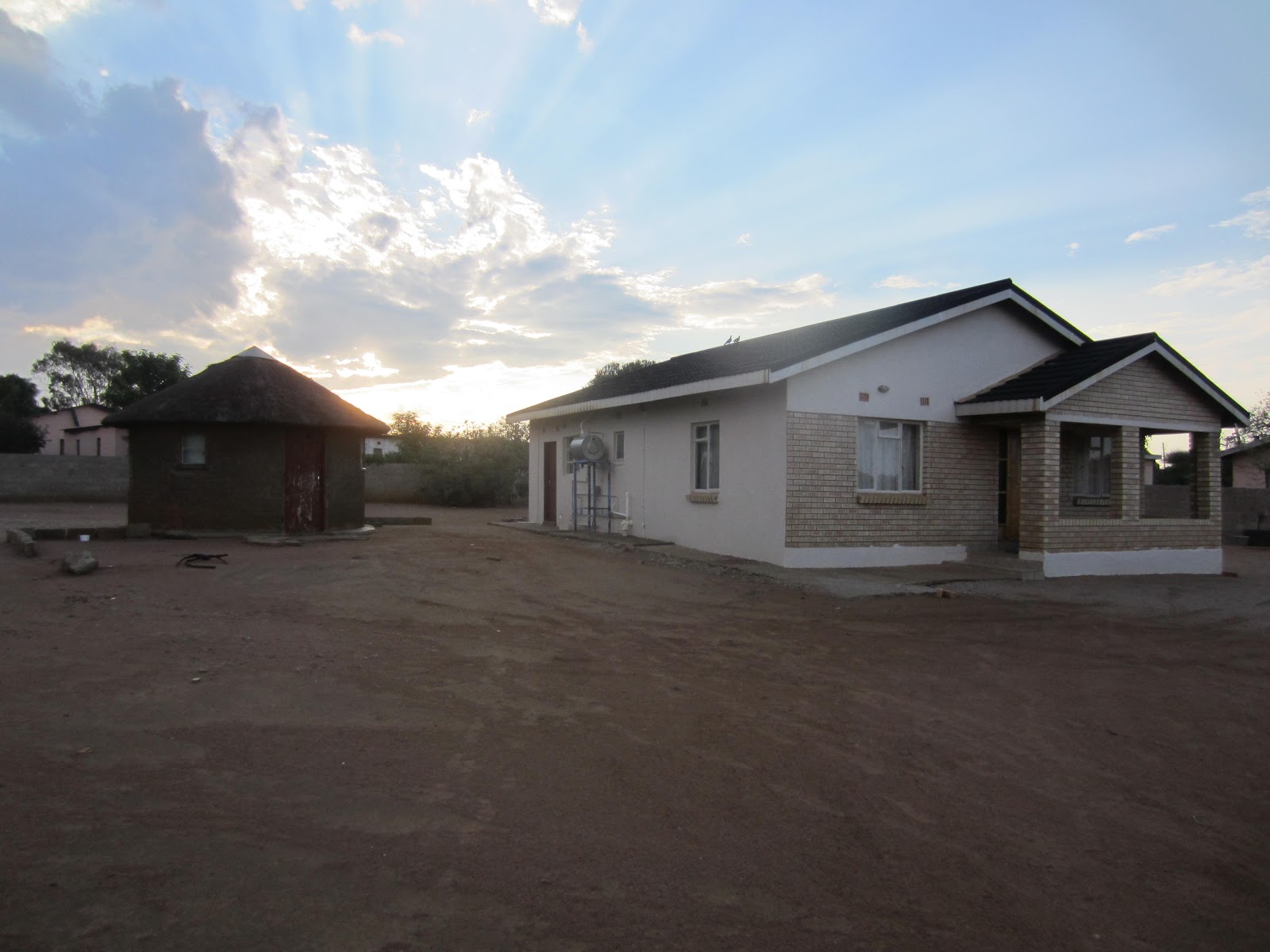
So I am doing my 2 month training in Kanye, a town outside of Gaborone (the biggest city and capital). My new Batswana host family includes Kaelo, a Motswana mother and her two sons Mpi and Thapelo (in their late 20s/early 30s). They live on the compound with us (pictured above), while Kaelo has several other children living in Gaborone now. Cousins also seem to come and go, as there is a 12 year old girl who is full of sass here now, but is going back to school soon. I think. I’ve also met several other members of their family who ask me some basic questions in Setswana, which I fumbled through, they laugh, I laugh and then they resume talking about the lekoga (the non-African) and other things in Setswana. It’s been pretty fun though, in general the Batswana are really sociable and friendly and we spend a lot of time laughing. My family, especially the brothers, speak English so we can communicate outside of playing charades.

For all of those who have ever lived with me or just made fun of my bathing habits…. In my first weekend at the home stay, I have already been told I need to ‘bath,’ not bathe, twice a day. I saw this one coming, but hoped that I would be able to avoid it for at least a little longer. Right off the bat my host mom, Kaelo, asked me if I wanted to bath again. No thanks, I replied hoping that would be the end of it, at least for a few days. No go though, she pressed on, with all the assorted family in the room roaring with laughter and disgust. Sigh, “here people bath twice a day, right?” “YES.” Okay, Kaelo. You win. I’ll bath twice a day. I am going to see how long I can go without washing my hair though. That is significantly less fun with a bucket instead of a showerhead.
Actually being here though, I can see the reason behind the twice daily cleansing. My feet are filthy, and while it’s getting colder now (think 80s, some of the time, 90s other days, which the Batswana are bundled up in coats and blankets, thinking I’m crazy in my T-Shirt) there is still a fair amount of sweat, dust, and bug repellent that comes up. Still, I think a night time bath makes more sense to me.  But, in the spirit of cultural immersion, I will be succumbing to the twice a day bathing, at least until I am at site. I already want to chop my hair off though.
Other First Impressions:
-Song and dance have already broken out twice during the Peace Corps/Host family activities. YES. Hopefully I’ll learn a little while I am here, the Batswana can break.it.down.
-I have indoor, hot water and electricity in my homestay. Definitely wasn’t expecting that. It also means my host family watches Btv (Botswana TV) and SATV (South Africa) all of the time. They also have two tvs playing two different shows at once, side by side. Even if only one person is watching tv. I don’t think this is typical though.
-My Setswana name is Lorato, which means Love. I think it’s a nice name, although I confuse people with three names now.
-Roosters/donkeys/mystery animals suck. I was beyond tired when I went to bed last night, and I still woke up about five times during the middle of the night to them making animal noises. We had been warned, but I am going to need to find some ear plugs.
- Some of the rooms do not have finished ceilings, such as my bedroom. This means that every sound echoes off the tin roof and back into my bedroom from the rest of the house. No secrets here.
- It’s quite a bit greener then I was expecting. None of the trees are tall, but there is a lot of shrubbery.
-I’m still feeling the bliss :)